- Home
- Krav Maga Blog
- Krav Instructors
- Train in Israel
- Tour Train Israel
- Krav Shop
- DVD
- Kickboxing
- IKI Near Me
- Seminars
- IKI Membership
- On-Line Training
- Krav Maga Training
- Testimonials
- History Krav Maga
- Instructors Page
- Past Blogs
- Spanish
- Italian
- Certification
- Contact
- Holland Seminar
- Vienna Seminar
- Poland Seminar
- Italy Seminar
- Belt Requirements
Talmud Krav Maga Trying
BY MOSHE KATZ
CEO
ISRAELI KRAV INTERNATIONAL
September 20, 2026, Israel

Talmud is an integral part of our system of Krav Maga.
How so? and what is the Talmud?
The Talmud is the central text of Jewish law and life. It was written over a period of 500 years, from 0 - 500 C.E. and contains centuries of tradition, discussion, debate and argument covering all aspects of life. It is the foundation of Jewish cultural and religious life. The discussions concern the Hebrew Bible and the traditions passed down from the time of Moses (Moshe) to the year 500. There are two versions; the Jerusalem Talmud and The Babylonian Talmud. The Babylonian Talmud is one studied most often. Due to Roman Christian oppression the Jerusalem Talmud was unable to be properly completed.
The Babylonian Talmud contains 63 tractates (treatise, sections) including 2,711 huge double sided pages. It is written in ancient Hebrew, Aramaic, Latin and Greek. One who can master the Talmud can master anything.
The discussions/arguments in the Talmud are very complex and often convoluted, yet always brilliant. These leads to what is known today as "Talmudic Logic", it is also why Jews generally make very competent lawyers. Basically, anyone who studies the Talmud is studying the Law.
This way of thinking colors our approach to life and Krav Maga.
Here is a passage which might seem a little difficult to understand, so I will summarize the key point before you read it. In the Talmud the rabbis and scholars derive laws from extra words that seem superfluous, but in reality, teach us some subtle point of the law. In this discussion they are debating laws derived from the Hebrew word "et" which is a connective word that does not exist in English, so just take my word for it. Shimon HaAmasoni, a scholar was interpreting this little connective word, until he reached the law - you shall fear the Lord your God, and the implication would be that if the word "et" added something it would imply that there are additional Divine Beings, or other "gods", which is opposed to the belief of Judaism. At this point Shimon HaAmsoni dropped his case and gave up his argument. His students asked, but what about all the laws that you interpreted until now? And the teacher answered, I will drop them, I am dropping the case. However, my time was not wasted, because I received Divine reward for studying the Bible and the Law, and now that I realize my argument was false, I also receive Reward, or credit for admitting I was wrong, and dropping my case.
And then another great scholar came along, Rabbi Akiva and he actually was able to interpret the "et" without negative Jewish belief and understanding, that is the word "et" comes to teach us the fear Awe of God (incorrectly translated as fear) comes to include the respect that is due to scholars.
As it is taught in a baraita: Shimon HaAmasoni would interpret each and every occurrence of the word “et” in the Torah, deriving additional halakhot with regard to the particular subject matter. Once he reached the verse: “You shall fear the Lord your God” (Deuteronomy 6:13), which is written with the added word “et,” he withdrew from this method of exposition, as whose fear could be an extension of the fear of God? His students said to him: Our teacher, what will be with all the occurrences of “et” that you interpreted until now? Shimon HaAmasoni said to them: Just as I received reward for the exposition, so I receive reward for my withdrawal from using this method of exposition.
The word “et” in this verse was not explained until Rabbi Akiva came and taught: “You shall fear the Lord your God”; the word “et” in the verse serves to include Torah scholars, i.e., that one is commanded to fear them just as one fears God. (Talmud, Bechorot, 7B)
Now how does this relate to our approach to self-defense?
In IKI we approach each situation with an open mind. We try to "interpret the situation", but sometimes, like in the case of Shimon quoted above, we do not succeed at first. We give it our best efforts but sometimes there will be a case where this defense does not work. So we drop it and "credit" ourselves with trying. Now the key here is that all that trying, that trial and failure, is not wasted, not at all! We can credit, we gain experience, by trial and error, and then, just as Rabbi Akiva came along and demonstrated that in fact Shimon was on the correct path, we do will find that these experiments in self-defense will ultimately lead us to better, more correct solutions. Eventually the trial and Error, the failures, will lead to success.
The intellectual battles of Talmudic study are not conducted with anger, or ego, but are simply the pursuit of truth. The goal is to increase wisdom; it is all for the sake of a higher cause.
This is very relevant to IKI Krav Maga. We are truth seekers, while the above pertained to our spiritual lives, Krav Maga pertains to our physical lives. As such we will argue and debate. I will present a technique to my team and say, now you try it, tell me what you think. At a seminar I will always say, Does this make sense? this is not rhetorical question. If it does not make sense, challenge me, respectfully, this will lead to debate.
This argument took place about 1,800 years ago but we are still debating these words and they are still relevant. Our Talmudic tradition has created a culture of intellectual pursuit like no other. IKI Krav Maga is a product of this culture.
IKI On Line Membership and Training
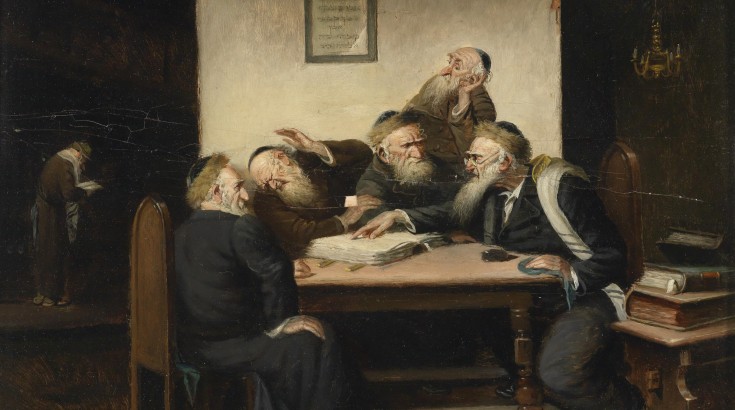
Talmudic scholars in action, the endless debate, No Holds Bar studies.