- Home
- Krav Maga Blog
- Krav Instructors
- Train in Israel
- Tour Train Israel
- Krav Shop
- DVD
- Kickboxing
- IKI Near Me
- Seminars
- IKI Membership
- On-Line Training
- Krav Maga Training
- Testimonials
- History Krav Maga
- Instructors Page
- Past Blogs
- Spanish
- Italian
- Certification
- Contact
- Holland Seminar
- Vienna Seminar
- Poland Seminar
- Italy Seminar
- Belt Requirements
The End Future
BY MOSHE KATZ
CEO
ISRAELI KRAV INTERNATIONAL
October 3, 2026, Israel
There is no End.
Earlier today we read the end of the Book of Dvarim/Deuteronomy, this is the end of what is called The Torah, the Five Books of Moses, or the Pentateuch. However, the ending is rather strange, as it is not really an ending. It ends almost like a TV series that leaves you hanging and wants you to sign up for the next season. The book ends with People of Israel so close to Israel, Canaan, The Promised Land, and yet they do not enter, not yet. There arrival is still in the future. Thus, the Torah does not end with the End but rather with a look towards the future. We are not yet at a conclusion, and here is the point, we never shall be, for in this life, according to our philosophy, there is no conclusion for the living. There is no retirement. As long as we live, we grow, and our task is never completed.
We end this book with The Nation of Israel still on the journey. This "ending" dramatizes the fact that our journey points to the future.
He [Rabbi Tarfon] used to say: It is not your duty to finish the work, but neither are you at liberty to neglect it; (Ethics of the Fathers, pre 200 C.E.)
Thus, we find the People of Israel, still in the desert, not yet entering, and their leader, their guide, Moshe, comes to the end of his journey on this earth and passes away. This reminds me of the profound words of Franz Kafka
It is a human life
Franz Kafka writes in his diaries about Moshe, Our Teacher. "He is on the track of Canaan all of his life; it is incredible that he should see the land only when on the verge of death. The dying vision of it can only be intended to illustrate how incomplete a moment is human life, incomplete because a life like this could last forever and still be nothing but a moment. Moses fails to enter Canaan not because his life is too short but because it is a human life."
What we see here is the inherent incompleteness of human life. Thus, the idea in the Ethics of the Fathers that your life is not the completion of the task but part of the process; we are all just part of an ongoing process of growth and development. Incompleteness is an inherent part of human life.
In our Jewish tradition, when you finish a chapter or a volume of Talmud, you do not take a pause, the custom is that you immediately begin the next chapter or volume, read at least the first passage and then you can pause for the day. The concept is; there is no end. Even when one achieves the incredible milestone of completing the entire Talmud, one immediately goes back to the beginning to start again. Likewise in the Talmud there is no page 1, it always begins one page 2. The idea is there is no beginning and no ending, just constant continues study.
We have adopted this tradition in IKI Krav Maga.
IKI Krav Maga is an ongoing process of development, and it too, has no end. That is why we do not spend thousands of dollars in producing professional quality DVDs, for tomorrow we may discover or develop an improved technique, and we do not want to be stuck with outdated material. We are always looking to the future.
Imperfection is an inherent quality of human life; daily effort is required, and growth is never ending.
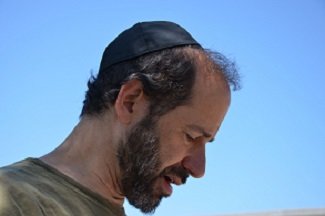
Moshe Katz, 8th dan Black Belt, Israeli Krav Maga. Certified by Wingate Institute. Member Black Belt Hall of fame, USA and Europe.
Understand the Israeli Fighting Mentality - Israel a Nation of Warriors by Moshe Katz

What is the cultural background of Krav Maga? What makes it unique? What makes the Israeli military so effective? Why are Israeli security systems used all over the world?
What are the Biblical origins of Krav Maga and who was the first Krav Maga instructor?
What weapons and military strategies did our Biblical ancestors use?
How has Krav Maga developed in Israel and what are its goals?
All that and more in this unique book.
Start Your REAL Training TODAY
Or is someone coming to save you?
IKI Krav Maga online distance training - Leading to ranks and certification.
Tour and Train Israel Experience
Personal Training - If you are interested in personal Krav Maga training please contact us on the form below.