- Home
- Krav Maga Blog
- Krav Instructors
- Train in Israel
- Tour Train Israel
- Krav Shop
- DVD
- Kickboxing
- IKI Near Me
- Seminars
- IKI Membership
- On-Line Training
- Krav Maga Training
- Testimonials
- History Krav Maga
- Instructors Page
- Past Blogs
- Spanish
- Italian
- Certification
- Contact
- Holland Seminar
- Vienna Seminar
- Poland Seminar
- Italy Seminar
- Belt Requirements
Principles of IKI Krav Maga
BY MOSHE KATZ
CEO
ISRAELI KRAV INTERNATIONAL
January 1, 2026, Israel
IKI Krav Maga is the latest evolution of Krav Maga. While I have written about this extensively over the years, people still ask me to summarize the key differences, on paper, in words. This is challenging, it is much easier and more effective to demonstrate this in person, as I have done countless times all over the world, but I shall try and comply with this request.
My background in martial arts, and other sources of wisdom, is extensive. I say other sources of wisdom because wisdom can be found anywhere and applied anywhere. The lessons that I apply to our style of Krav Maga come from my many teachers, and my life experience. These teachers include martial artists, rabbis, students, university professors, all this wisdom of the ages can be applied to self-defense. One need not be a martial artist to have wisdom that can be applied to martial arts. Or as the late Professor Amos Funkenstein said to me, "One does not need to be a triangle to teach geometry." (Funkenstein was recognized and regarded as a true genius.)
I have applied my extremely diverse martial arts training, the wisdom of my teachers and parents, a lifetime of study of Talmud and history, including degrees in political science and economics, to the art of IKI Krav Maga. And I must thank and acknowledge my students, my team who have stood by me for close to 20 years of teaching, experimenting, and testing, often at the costs of pain and injuries to their own bodies. Everything we do is analyzed, questioned, tested full contact with full resistance, and then periodically tested again. That is why we do not invest money in fancy video productions. When one invests thousands of dollars in DVDs and videos, one must stick to that program until a profit is made. We do not invest money in this, and we drop and modify techniques as needed. We are slaves to no man, nor to the almighty dollar. We pursue truth at all costs.
Easy to Learn, Easy to Apply, Easy to Remember - During my years in martial arts I learned countless techniques, but then, unfortunately, I forgot most of them. When I was at Karate College, I was known as "the guy who took notes", Renzo Gracie jokingly asked if he could borrow my notes to write a book. When I questioned participants at the end of the course, most "had a great time", but "could not remember much". Bottom line, most people forget most of what they learn. Of course, they remember the foundations, a karate man will remember his kicks, a boxer will certainly not forget his punches, a Judo man will not forget this O Soto Garei, but when it comes to self-defense techniques, against a knife attack, a gun, Multiple Attackers, Active Shooters, knife threats, Hostage Situations, Airlines self-defense etc. Oh yes, it is very difficult to remember, and as a student and as an instructor of many years, I can tell you that most people forget most techniques.
While a student, and then instructor, at the gym of Itay Gil in Jerusalem, I conducted a certain experiment: Many of the young men who came to train were seeking to improve their chances of being accepted to top military units. After some time training, they were all drafted. From time to time, during vacations, breaks, they would return to train. I would watch them and take note: how much, and what, did they retain? What did they forget? I found that they retained very little. After a few months of not training actively in martial arts, they could not remember most of the Judo throws, the knife defenses or the jujitsu joint locks. But they could remember their kicks, elbow strikes, some basics. With those their form was excellent.
My conclusion: Focus only on techniques that people can remember, and build around that. Techniques that take months to learn and weeks to forget, are a waste of time.
Gradually, over many years, this involved into a key principle of IKI. All techniques, in order to qualify as an IKI technique, must be Easy to learn, Easy to apply in diverse situations and Easy to remember even if you have not trained in a while. I will elaborate a little.
Easy to Learn - A technique should not take months to learn. If a reasonable person cannot become proficient in the technique in a reasonable amount of time, then we drop the technique, not the student. This is not the norm in martial arts. The norm is - keep training, a year, ten years, eventually you will get it. If a student does not get it, he is dropped, not the holy technique. That is not our approach. Techniques must be easy to learn, or we drop them.
Easy to Apply - If you learn one technique and you can only apply it to one specific situation, we are not interested, we drop it. With IKI, you learn one concept, and then you learn to apply it to an infinite number of related situations. You might encounter a situation "out there" that we have never covered in class, yet you will know how to apply the concept we learned in order to successfully defend yourself. This has happened many times over the years. Learn a concept (more on that soon), a simple technique, and apply it. If the technique/concept cannot be applied to other situations, we drop it, it is a waste of storage space in your brain.
Easy to Remember - Life happens, most people are not full-time martial artists. I am a full-time martial artist and yet I too had trouble remembering techniques. Unless it was something I practiced regularly, I forget it. As an instructor I had to teach the basics to all students, but only few students reached the higher levels, as such, I did not get to review the more advanced techniques, and I forgot them and had to check my notes and drawings. Remembering a technique under the stress of a real-life violent attack is much more difficult than remembering it in class, or for a belt test. Thus, I made the decision, if a technique was not easy to remember, I dropped it from our curriculum. Martial arts must adapt to the people, not force people to adapt their lives to martial arts. Most of us are not monks living in the Shaolin Temple. We have lives, jobs, families, studies, religious and civic obligations. We adapt the art to the person.
Concepts, not Techniques - Most styles of martial arts are a collection of techniques. A student might have a notebook, or even a published book, with the list of techniques. We do not. We do have techniques of course but they are secondary to the concepts. Some of these concepts will be explained further on in this article. The techniques are built upon concepts, simple body movements that are not only easy to learn and remember but that are repeated throughout our curriculum such that as a student learns a "new" technique, he will notice the similarity. I often put it this way, with the first technique, "Wow, that is amazing". After 3 - 5 techniques, "I see a pattern here", after 8 - 10 techniques, "I get the concept, I can now create my own techniques as situations arise, teacher, you are dismissed."
Now of course we still need our teachers, but the idea is that once the student understands the concept, he can solve the problem himself. I, myself, will sometimes forget a technique for a particular situation, but then I apply the concept and "recreate" it, or come up with an improvement. Thus, it becomes not memorizing endless techniques but rather understanding a few basic concepts. The difference is a total game changer, but this is no game.
The Three Amigos - Speed, Strength, Precision. We call these the Three Unreliable Friends, the term Three Amigos coming from a popular movie and I use it as memory device. Most style of Krav Maga pride themselves on power. Women are trained to be like men. In fact, on one of the TV shows one of the women elbows a student in the face. Great for entertainment, but that is not our way. Speed, Strength and Precision are great qualities to possess, but if your technique depends on them, relies upon any of these qualities to be effective on the street, then we reject it out of hand.
Why?
Speed - Under the stress of a real-life violent situation you will be nervous, it will be difficult to be fast. In addition, why would you assume that you can be faster than your attacker? Speed is an unreliable friend.
Strength - If a technique requires "muscle" to make it work, simply put - it is not a good technique. Anything can work when you force it, assuming you are stronger than the other person. When I see students "forcing" a technique, I know that they have not yet understood the technique, if our techniques are done correctly, they don't need extra muscle. The assumption is that your attacker has chosen you for a reason, most likely he is stronger than you, now if your technique relies upon strength, muscle, to make it work, you will be outmuscled and out of luck. If a technique only works with extra muscle, we reject it. What use is a technique that only works if you are stronger than your opponent? In my opinion, of none-whatsoever.
Precision - When we are nervous, we lose the ability to be precise with our movements. I learned this years ago while being fired upon by some antisemite, simple tasks like inserting a key into a lock, normal everyday activities, become nearly impossible. Thus, when we learn complicated techniques that involve grabbing a certain point on a person's hand and twisting it a particular way, well, under stress, that becomes impossible. Even Hollywood stunt actors often need to redo such techniques over and over until it comes out right. Life is not a movie; you cannot do a "retake". If a technique requires precision in order to work, we drop it. We only use gross motor movements, no grabbing, no twisting of hands or wrists. We leave that for the movies and actors.
Perfect style for Imperfect People - Even Olympic athletes and professional tournament fighters have trouble pulling off complicated techniques under stress. We accept the fact that we are not perfect, we are not Olympic athletes or world champion fighters, we are ordinary, average, human beings with our faults, our good days and our bad days. Thus, our style is designed for the average person, with average abilities, and an average amount of time and income to devote to self-defense training. If you are above average - good for you! You will master our techniques even faster.
A style for all Ages - All conditions and body types. A continuation of the previous point. We grow old, if we are lucky. Great athletes shine in their prime and then, they retire. Sixty-year-old men do not play professional baseball or basketball, but sixty-year-old men and women do need self-defense. Our bodies and our abilities change as we grow older, and many of us suffer injuries or illness along the way. At IKI we recognize this, our techniques are designed for all ages, all sizes, men and women of all types and abilities. We are an inclusive style.
APC - Ability, Purposes, Circumstances - This refers to the way we handle an attack. Do we block and run? Block and Control, or Block and Destroy? In the Israeli military one of my students came back and told me, "We were taught never to retreat but always to finish off the attacker, to destroy him."
I said, OK, your sister is 4 foot 11 and petite, do you think she can disable a terrorist high on drugs and religion? Answer: Ah, I hadn't thought of that.
Me: And what about if it were not a terrorist but a soldier cracking down under pressure and attacking with a knife or pointing his rifle at other soldiers, do you want to break his neck? Answer: ah, no, not really. Me: OK, then, let's begin the lesson.
I teach an initial defense, and then after that, after the immediate threat has been removed, we have different options for a follow-up. The follow-up depends upon three factors: your ability, your purpose in being there, and the circumstances.
Ability - On the low end, you might have had a couple of weeks of Krav Maga training, perhaps not in great shape, a petite female. On the other end of the spectrum you might be a strapping young male, fit and muscular, standing 6 foot 2, a black belt in several martial arts and a military veteran with combat experience.
Purpose - On one end of the spectrum, you could be a passerby in a conflict that does not involve you. This means you really have no purpose in being there and no reason to stick around. On the other end of the spectrum, you could be a professional security guard hired for the specific purpose of protecting this venue.
Circumstances - On one end of the spectrum you might have the following circumstances: you are alone in a parking lot and are attacked, i.e. no reason to stick around. On the other end of the spectrum you might have the following: It is a place of worship, there are elderly people in wheelchairs, there are young women pushing baby carriages, there are children.
Now let's put all these together, APC.
On one extreme you might have a petite female with 2 weeks of training, not in a great shape, alone in a parking lot. i.e. Ability - Low. Purpose - No purpose in being there, no reason to stick around. Circumstances - She is alone, there is no one she needs to think of but herself. Conclusion - Block, hit and run, just get away as soon as possible.
Another extreme: You might be a security guard, a combat veteran, MMA champion, Krav Maga black belt, 6 ft 2 and full of muscle. i.e. your Ability is High. Purpose - your purpose is to defend others; you were hired as security. Circumstances - There are many vulnerable people here, young and old as we described earlier. Conclusion - Block, fight back, stay until the threat is eliminated or backup arrives. You are not to run away, no matter what.
Thus, when asked, in IKI Krav Maga, what is the follow up? I answer the question with a question, what is your APC? based on that you will know how to respond.
The Concept of Awareness and Imaging, a key to survival - Not just the physical. As I grow older and grow in life and martial arts experience, I realize that the mental role is far more important that I was initially led to believe. Whereas years ago, it was standing in a row, punching and kicking in the air and shouting our "Kias", now I realize that most of self-protection involves paying attention, noticing what is around you, seeing problems before they happen. In a word, as Mr. Miyagi said, "Best defense - not be there." This is a great truth. Situational Awareness is not just a slogan with us, it is a way of viewing the world, a way of life. In addition, we use Imaging, which means if I am standing at a bus stop, I am taking note of everyone around me and imagining attacks. What if that man pulled out a knife, what if that person pulled out a handgun, what if...it is more than just being aware of our surroundings, it is playing out scenarios in your head. Psychological studies have proven that when an attack takes place, those who have already "experienced" these attacks in their imagination, are better able to respond, and faster.
This training was ignored in nearly all the styles I had studied, but we believe it to be an integral part of our training.
Psychological Readiness - Having fantastic martial arts skills, great levels of fitness, flexibility, and endurance is a good start, but it is far from enough. In fact, it is not even close to being enough. People are afraid, people panic, and they cannot use their well-honed skills. I have written many blogs about his, here I will suffice with my favorite analogy, you are an expert electrician, years of experience, you arrive on the scene, you understand the problem. You have your toolbox, and the customer in need is wondering why you are not working. You have the tools, you have the skill, you have the time, but sadly your toolbox is locked, and you lost the key. That sums up most martial arts. We need to train for psychological readiness in order to be able to retrieve your tools when you need them.
Real Life Case Studies - Our techniques are not "dojo" techniques, or tournament techniques, or art or exhibition techniques. All our training is based on real life violent cases, as reported by eyewitnesses, the victims or heros themselvs, or surveillance cameras.
The Defense must begin Immediately - I used to read many martial arts magazines, actually I did not read them, I studied them. My favorite section was the technique part, a technique explained in detail accompanied by photos. Generally, I had trouble with the first step, which was something like catch his punch in mid-air, or, grab the knife hand and twist, so I would skip the first part and work on parts 2 - 17B, and figure I will get back to part 1 later and try and figure that out. But that does not work. If you failed part 1, you failed, period. So IKI takes a different approach. While all techniques are kept simple, the first move is the most important. And the first move must be to get you out of the immediate danger. This means we do not waste moves; we do not begin by talking, we do not begin by moving our hands into a position from where we can do a great defense, it means defending from where we are now. The defense beings with the first body movement that we make, not with the second or third. If your technique depends upon you "getting the first move for free", then you are in trouble. For example, our choke defense does not begin with moving our hands to grab the attacker's hands, that is way too late, not effective or realistic at all. We begin with body movement, come see it in person, I don't teach via blogs. The first instant of the technique, the first movement must get me out of the most immediate danger. The rest will follow.
Respond to attacks before we have the full picture - Operate in Chaos. In martial arts, defenses often seem like perfect responses. You know exactly what the attacker has planned and you defend accordingly. I spent years doing this with all sorts of systems, the video of the month etc. But the truth is real life is total chaos, and you really don't know what is coming next, or at all. Thus, we must operate on the principle of chaos, unpredictability. We have to sacrifice Specific Defense on the altar of survival and replace them with General Defenses. It is analogous to general health maintenance against disease as compared to a specific medicine against one particular disease.
When the attack comes in you often have no idea if it is a punch, a push, an elbow, a knife, a fake, a feint, a trick of some sort, you simply do not know. But the guys and girls on Youtube do know, and that is why their defenses look so impressive, but we do not know. So we offer a more general, a wider, defense, and this enables us to adjust it and adapt it to whatever comes our way. Again, to truly understand this you will have to come to class, or a seminar at least. The principle here is - specific defenses only work when you know the exact nature of the attack, but real life is not like that. Prepare for Chaos. That is what we do at IKI.
Total Body Movement - In most styles of martial arts we see a lot of focus on hand movement, the defense for a choke or a knife involves grabbing the opponent's hand. I did that for years until I realized the folly of it. We drop anything requiring precision, we drop anything requiring fine motor skills and we use only Gross motor movements that utilize the entire body. That means every movement I make has my entire body behind it. I don't have a movement that depends upon my arm strength alone, every move incorporates the power of the entire body, this way a smaller person can succeed against a larger more powerful attacker. It is never a test of strength. It would be my Total Body against his wrist, my Total Body against his grab. That is why it works. Self-defense is not an arm-wrestling match.
Flow of Energy - To increase power we employ the flow of energy in the same way that a windmill produces power, or a propeller. It is not our muscle alone; it is the way the energy flows throughout our body. This concept is utilized quite well in the various branches of Tai Chi Chuan and other Chinese martial arts. IKI has adopted these principles to our defenses. Using the Flow of Energy both increases our power and impact while lowering the energy expended.
Use Surprise to your Advantage - In IKI we understand that we will be surprised. This is unavoidable. In other systems that I had trained in the idea was just to defend and the assumption always was that we were not caught by surprise. But the truth, the reality, is we will indeed be caught by surprise. We are not the ones initiating the engagement, the attack. Thus, our approach is to accept this reality and learn to respond to it correctly. Our approach is to design our defense with the assumption and understanding that we may be caught by surprise, and thus we use the surprise to our advantage. Our defense is built upon this premise and uses the energy of the surprise to our benefit. As a way of example, if the attack startles us, we use that body reaction as part of our defense. Thus, we don't fight nature, we adapt to it.
Dont' fight the body, learn to work with it - Do not learn to "overcome" your body, your natural hard-wired system. As a continuation of the preceding point. We do not try to overcome our body's natural reaction, even if it is fear, rather we learn to use that energy, that body movement, that instinct, to our advantage. Similarly, we do not try to "be the Tiger" or the dragon, we try to be the human being, nothing more. We use our natural instincts and abilities, we work with what we have, not against it. This leads to faster learning and a faster reaction time.
Make it your own, Adapt to your body - We are all individuals. Some of us have injuries, some are tall, some are short. Some have a few extra pounds; some are very thin. We take the concepts, and we make it work for our bodies. The system is made for the people, not the people for the system. Make it your own individual system using our concepts.
Fight Your Own Fight - My Wing Chun teacher, Sifu Chun Kwok Chow, taught me an invaluable lesson. I am taller than him, but he moved in quickly, and said, "I will play the inside game, strike you from inside your defensive zone, close in. You are a tall American guy with long legs; I will not let you use those long legs against me with your powerful kicks. I am a short Chinese guy, I will fight my fight, I will not let you fight your fight. I can win at my fight."
I have never forgotten this lesson, and it is incorporated in IKI Krav Maga. A small person may not be able to defeat a larger person in a "fight", that is why our system is not built around being a so called "Krav Maga Fighter", we are defenders. If you learn to respond in a way that suits your body, rather than a generic martial arts kata-like response, you will have a better chance of survival. Fight your fight and you will have the advantage. We are not a cookie-cutter system, not a "One size fits all" store.
One movement, many techniques - Universal Block, The Ginga. As Bruce Lee said, we rather have ten techniques that work for us than one hundred that work against us. In IKI we have two gun defense and we apply them to literally hundreds of different scenarios (see our online program). We have the IKI Universal Block, which is applied to defense vs punch, knife, forarm, push, shove, etc etc. The Ginga vs hand grab, shirt grab, push, choke, knife threat, etc. and more. Come to class to experience for yourself. One of our students in California said he learned more with me in one hour than he did in years in his local Krav Maga school, and he was in his 70's. Never too late to learn.
Reduce complexity to simplest components - As Bruce Lee said, our goal is simply to simplify. Reduce complexity to a system everyone can learn quickly. I have distilled more than 40 years of training to a program that you can learn in a few weeks, at least the foundations to defend yourself.
Trust Fear - Fear is a gift, and we use it. We do not try to overcome fear; we learn to cope with it and use it to our advantage. If you sense fear, that is your early warning system and it is time to evaluate the situation and take appropriate action. Never dismiss fear, embrace it and use it.
Summary
IKI is an evolution of many martial arts and a lifetime devoted to trying to keep people safe. It has evolved into its own unique system. Our techniques, our training methods, our emphasis, the psychological elements, the human elements join together to create something new and unique. The effectiveness of the style is in its totality. Each part is an essential ingredient of one holistic whole, and it is all based and designed around your needs, your ability and your survival.
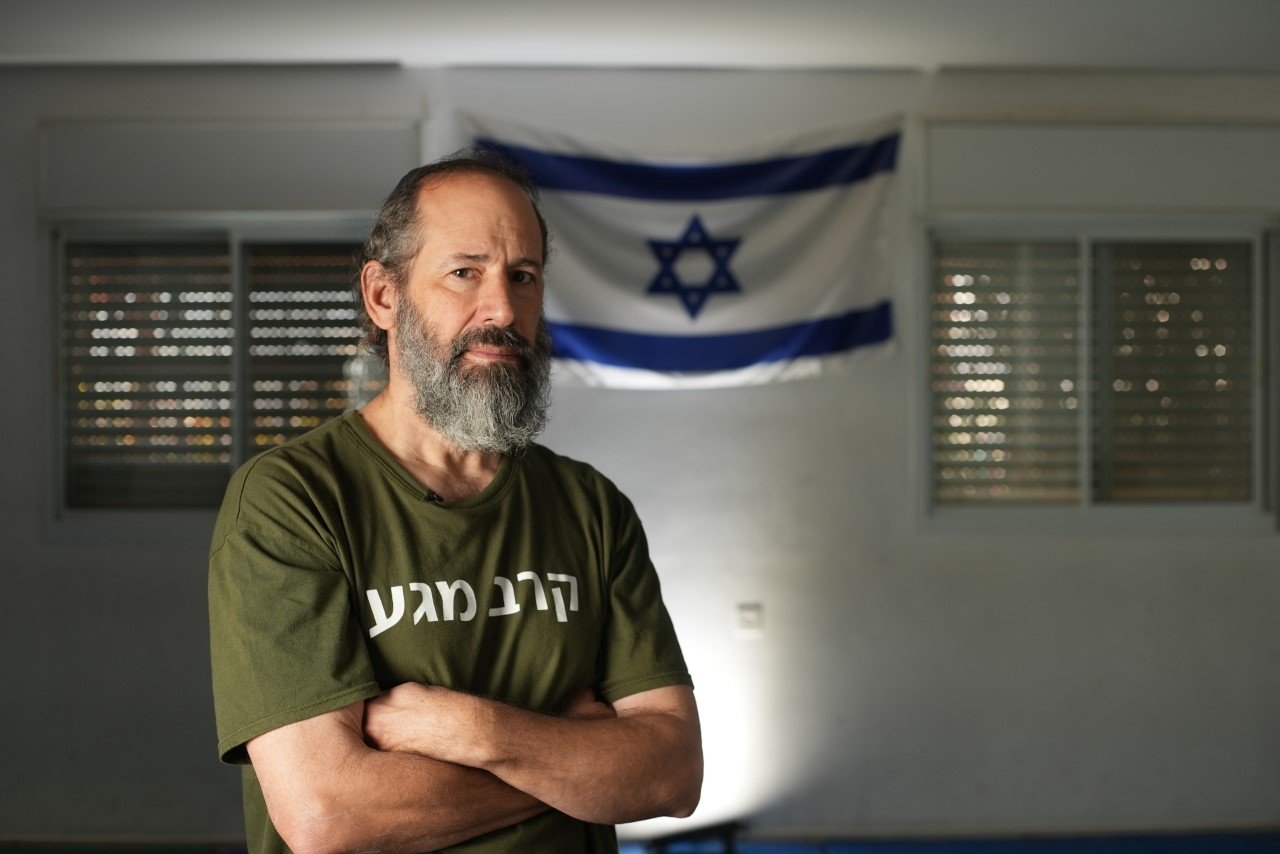
Moshe Katz, 7th dan Black Belt, Israeli Krav Maga. Certified by Wingate Institute. Member Black Belt Hall of fame, USA and Europe.
Understand the Israeli Fighting Mentality - Israel a Nation of Warriors by Moshe Katz

What is the cultural background of Krav Maga? What makes it unique? What makes the Israeli military so effective? Why are Israeli security systems used all over the world?
What are the Biblical origins of Krav Maga and who was the first Krav Maga instructor?
What weapons and military strategies did our Biblical ancestors use?
How has Krav Maga developed in Israel and what are its goals?
All that and more in this unique book.
Start Your REAL Training TODAY
Or is someone coming to save you?
IKI Krav Maga online distance training - Leading to ranks and certification.
Tour and Train Israel Experience
Personal Training - If you are interested in personal Krav Maga training please contact us on the form below.